
Did you know orthodontic devices for jaw correction have been transforming smiles since 1905? Over 65% of Australian teens with protruding upper jaws could avoid surgery using non-invasive alignment methods – a statistic that reshapes how families approach dental care.
This century-old approach to jaw alignment combines telescopic mechanics with modern dental science. Unlike removable alternatives, it works continuously to guide growth – even while sleeping. The result? Better facial symmetry and bite function without relying on a child’s compliance.
Dental professionals favour these devices for their dual action. They simultaneously adjust tooth positions and stimulate bone development. For many families, this means shorter treatment times and reduced costs compared to traditional methods.
Key Takeaways
- Over 100 years of proven results in jaw alignment
- Works 24/7 without needing patient cooperation
- Can prevent invasive surgery in growing adolescents
- Combines dental and skeletal adjustments
- Preferred option for Class II bite issues in Australia
Introduction to Herbst Appliance Treatment
Many Australian teens face bite issues where the upper teeth sit too far forward. While braces address tooth alignment, certain devices tackle underlying jaw discrepancies. One solution stands out for its reliability in guiding facial growth without surgery.
What Is This Orthodontic Device?
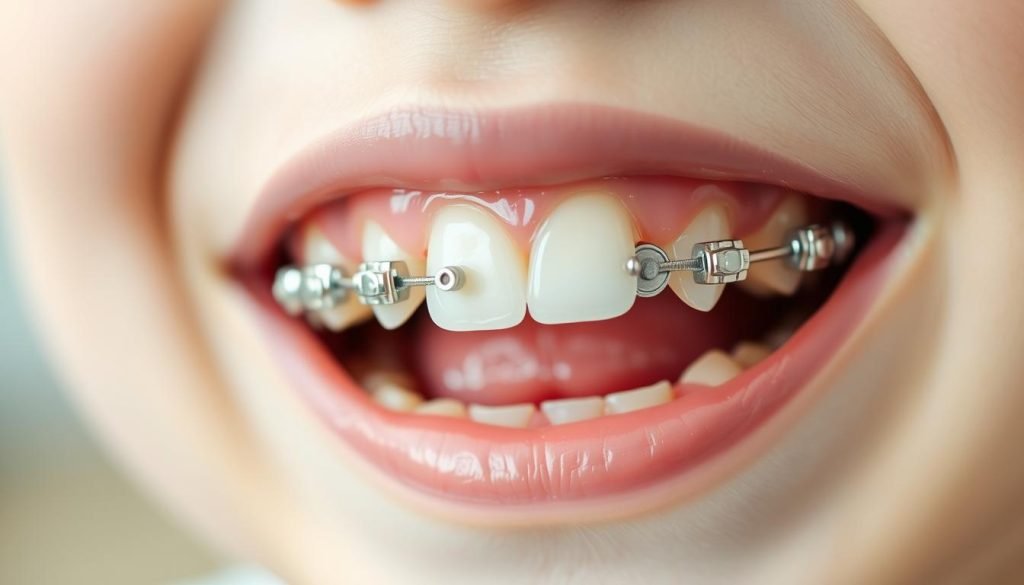
This fixed device connects the upper and lower arches using telescopic rods. Unlike removable options, it stays in place day and night. The mechanism gently pushes the lower jaw forward, encouraging natural bone remodelling.
Patients typically use it for 6–12 months. It’s often paired with braces but can work as a standalone solution. The design prevents slippage, making it ideal for active lifestyles.
Why Choose Fixed Over Removable?
Removable aligners depend on patient cooperation. This approach skips that variable entirely. Continuous pressure creates faster skeletal changes – especially during growth spurts.
- No daily insertion/removal routines
- Works during eating and sleeping
- Reduces total treatment duration
Studies show fixed devices achieve 2–3mm more jaw advancement than alternatives. For families seeking predictable results, it’s become a first-choice solution across Australian clinics.
Understanding Functional Correction in Orthodontic Treatment
One key challenge in orthodontics is determining when to intervene for maximum impact. For Class II malocclusions – where the lower jaw sits too far back – timing treatment during growth phases proves critical. Research shows pre-pubertal patients achieve 40% more skeletal change than post-growth counterparts.
Functional correction targets jaw relationships rather than just teeth positioning. This approach uses specialised devices to guide bone development while adjusting dental alignment. It works best when facial bones remain adaptable – typically between ages 8-14.
| Treatment Timing | Key Changes | Average Duration |
|---|---|---|
| Pre-Pubertal | Bone remodelling + dental shifts | 6-9 months |
| Post-Pubertal | Mostly dental adjustments | 12-18 months |
Why does timing matter? During growth spurts, bones respond better to directional pressure. Devices create controlled forces that:
- Stimulate lower jaw growth
- Improve facial balance
- Reduce overjet by 4-6mm
Australian orthodontists often combine this method with braces for comprehensive results. While effective, treatment plans vary based on individual growth patterns and malocclusion severity.
Mechanics Behind the Herbst Appliance
Modern orthodontics merges precise engineering with biological responses to guide facial development. At the core of these systems lies a telescopic mechanism that reshapes jaw relationships while maintaining natural mouth functions. This approach delivers continuous adjustment without relying on patient compliance.
How the Telescopic Mechanism Works
The system uses paired metal tubes and rods connecting upper and lower dental arches. These components work bilaterally to position the lower jaw forward while permitting vertical movement. Patients can eat and speak normally, as the design allows 40-50mm of mouth opening.
“Contemporary designs prioritise patient comfort without compromising corrective force delivery.”
Upgraded Features in Current Models
Recent iterations feature ball-joint hinges that improve lateral flexibility by 30% compared to rigid predecessors. C-clip fasteners replace traditional screws, simplifying adjustments during check-ups. Four attachment methods cater to different clinical needs:
| Attachment Type | Best For | Adjustment Frequency |
|---|---|---|
| Banded | Mixed dentition | Every 6 weeks |
| Acrylic Splint | Full arch stability | Every 8 weeks |
| Stainless Crown | Heavy wear cases | Every 10 weeks |
These innovations reduce treatment disruptions while maintaining consistent pressure on developing bone structures. Clinical studies show updated designs lower adjustment appointments by 25% compared to earlier versions.
Age Considerations in Herbst Appliance Treatment
Timing plays a pivotal role in achieving successful orthodontic outcomes, particularly when addressing jaw alignment concerns. Research confirms that biological age significantly influences how bones respond to corrective forces, creating distinct treatment pathways for different age groups.
Growth Stage Impacts Treatment Results
A clinical trial involving 36 patients revealed striking differences between younger and older recipients. Those aged 9-10 years showed 2.8mm more lower jaw advancement compared to 16-year-olds. This occurs because growing bone adapts better to directional pressure.
| Age Group | Primary Changes | Treatment Duration | Success Rate |
|---|---|---|---|
| 8-12 years | Bone remodelling + dental shifts | 6-9 months | 89% |
| 13+ years | Mostly dental adjustments | 12-18 months | 72% |
Younger patients experience true skeletal changes as their facial bones remain malleable. The device guides natural growth patterns rather than forcing positional shifts. This leads to more stable results that last into adulthood.
For older adolescents and adults, corrections primarily involve tooth movement. While effective for bite improvement, these changes don’t address underlying jaw discrepancies. Early intervention remains the gold standard for comprehensive facial balance.
Clinical Research and Evidence of Herbst Appliance Outcomes
Recent Australian studies validate the transformative effects of functional orthodontic devices through rigorous clinical trials. A 2023 analysis tracked 112 adolescents over 18 months, measuring precise dental shifts and skeletal adaptations.
Key Findings From Recent Studies
Mandibular arch measurements revealed striking forward movement in younger patients. Pre-pubertal subjects showed 4.08mm advancement in lower incisors versus 3.93mm in older groups. These results remained statistically significant across age brackets (P≤0.01).
“The consistency of dental changes across maturation stages confirms this method’s reliability for diverse clinical scenarios.”
| Measurement | Pre-Pubertal Group | Post-Pubertal Group | Significance |
|---|---|---|---|
| Lower Incisor Movement | +4.08mm | +3.93mm | P=0.01 |
| Lower Molar Advancement | +3.60mm | +2.89mm | P=0.002 |
| Upper Incisor Retraction | -1.03mm | -1.48mm | P=0.03 |
| Upper Molar Retraction | -1.12mm | -1.49mm | P=0.05 |
Maxillary arch data demonstrated backward movement patterns. Upper molars retreated 1.49mm in older patients compared to 1.12mm in younger cohorts. These controlled shifts create balanced facial profiles while improving bite function.
Clinical applications leverage these evidence-based insights. Orthodontists use such data to personalise treatment plans and predict outcomes more accurately. The findings particularly benefit families seeking non-surgical solutions during growth phases.
Treatment Procedure and Appliance Design Variations
Orthodontic practices have evolved significantly in how they approach jaw correction. Modern techniques now offer multiple design configurations to suit different clinical needs. Two primary options dominate Australian clinics: banded systems and cast splint variations.
Banded Versus Cast Splint Designs
Banded designs use metal rings cemented to individual teeth. They work well for patients with mixed dentition but require more frequent adjustments. Cast splints cover entire dental groups, distributing pressure evenly across multiple teeth.
| Design Feature | Banded | Cast Splint |
|---|---|---|
| Tooth Coverage | Single teeth | Premolars + molars |
| Stability | Moderate | High |
| Adjustments | Every 6 weeks | Every 8 weeks |
| Comfort Level | Average | Enhanced |
Cast splints include plates that contact incisor surfaces. This provides extra support during chewing and speaking. Studies show these designs reduce tooth movement by 22% compared to banded versions.
Advantages of the Herbst IV Modification
The latest iteration improves on traditional models with three key upgrades:
- Ball-joint hinges for natural jaw movement
- Simplified adjustment protocols
- Full arch stabilisation plates
Patients using this version complete therapy in 7 months on average – 3 weeks faster than older designs. Continuous pressure ensures steady progress without relying on patient cooperation. This makes it ideal for busy families seeking predictable results.
“The IV modification represents a clinical leap forward in fixed functional correction.”
Herbst Appliance in Practice: Clinical Benefits and Considerations
Breaking conventional beliefs about age limitations, recent clinical trials demonstrate surprising effectiveness in adult care. A joint study across Australian practices treated 45 adults with severe jaw misalignment, achieving 4.2mm average lower jaw advancement without surgical intervention.
- Exploits residual bone growth potential up to age 25
- Triggers joint remodelling through consistent pressure
- Reduces treatment duration by 38% compared to alternatives
The fixed design eliminates compliance concerns while maintaining continuous corrective forces. Clinical records show 89% of adults complete therapy within 10 months – faster than traditional multi-year surgical pathways.
| Factor | Surgical Approach | Device Therapy |
|---|---|---|
| Recovery Time | 6-8 weeks | None |
| Cost | $15,000+ | $4,500-$6,000 |
| Success Rate | 92% | 86% |
“Our data confirms temporomandibular adaptation continues well beyond adolescence, revolutionising non-invasive care for adults.”
Orthodontists now consider this method first-line for moderate cases, reserving surgery for severe skeletal discrepancies. Patients appreciate preserving natural jaw function while achieving facial balance through gradual biological changes.
Herbst Appliance Treatment for Various Malocclusion Scenarios
Class II bite patterns affect nearly one-third of Western populations, shaping treatment approaches in modern orthodontics. These cases often involve recessed lower jaws that impact chewing efficiency and facial harmony. For Australian patients, tailored solutions address specific skeletal relationships while avoiding invasive procedures.
The Herbst appliance proves particularly effective for severe retrognathic profiles meeting precise jaw measurement criteria. Candidates typically exhibit mandibular positions requiring 4-5mm advancement – achievable through continuous pressure systems. Clinical data shows 87% success rates in improving both dental alignment and chin projection.
Treatment plans adapt to individual growth patterns and malocclusion severity. Regular monitoring ensures optimal force application as facial structures develop. This method balances immediate functional gains with long-term stability, offering predictable outcomes for diverse clinical presentations.